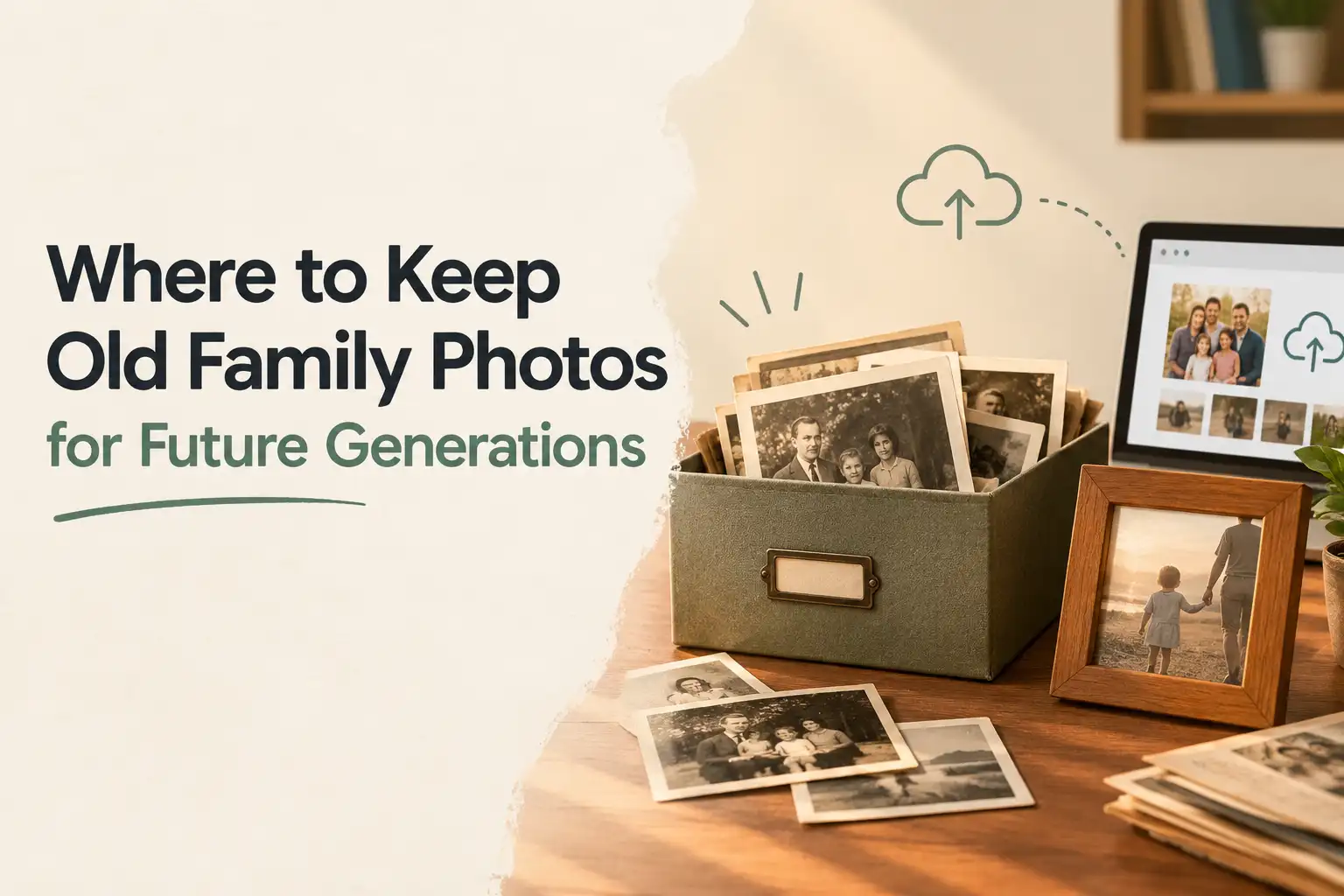
Short answer: No single service does everything well. For most families, the safest setup is two homes for your photos: an everyday cloud library your relatives already use (Google Photos or iCloud), plus one long-term home chosen for what matters most to you. That’s FamilySearch if you want it free and tied to your family tree, Permanent.org or Forever if you want to pay once instead of every month, or Theirs if the photos belong to someone who has died and you want the family to add their stories. Whatever you choose, keep a copy on a drive at home.
Prices and policies checked on October 7, 2026, against each company’s own help pages, pricing pages and terms. Sources are listed at the end. Disclosure: BringBack and Theirs are made by the same team. Theirs is included because it was built for one of the situations below, and it is judged on the same criteria as everyone else, weaknesses included.
Key takeaways
- Full resolution isn’t guaranteed. Google Photos’ Storage saver resizes photos above 16 MP. Older iCloud Shared Albums keep only a 2,048-pixel copy, although albums created or upgraded on iOS 27 now keep full resolution.
- Most “family” sharing still needs an account. Of the nine services here, only upgraded iCloud Shared Albums and Theirs let relatives add photos without signing up for anything.
- Family tree exports leave your photos behind. A GEDCOM file from Ancestry or MyHeritage holds names, dates and relationships, not the image files.
- What happens after death differs more than anything else. Apple deletes an account three years after a Legacy Contact first gets access. Google can delete accounts unused for two years. Amazon deletes Amazon Photos files after two years of inactivity. Permanent.org, Forever and Theirs let you name who takes over.
- You can pay once instead of subscribing. Permanent.org charges $10 per GB once, Forever starts at $179.99 for 10 GB, and Theirs charges once per memorial.
Quick verdicts
- Best for everyday family sharing: Google Photos
- Best if your family uses iPhones: iCloud Shared Albums (upgraded on iOS 27)
- Best if you already pay for Prime: Amazon Photos
- Best free long-term home for genealogists: FamilySearch Memories
- Best for researching a family tree: Ancestry (photos are secondary)
- Best for photo tools inside a family tree: MyHeritage
- Best nonprofit, pay-once archive: Permanent.org
- Best commercial “lifetime plus 100 years” guarantee: Forever
- Best for preserving one person’s life after they’ve died: Theirs
Comparison 1: cost and quality
| Platform | Free storage | Paid options (US) | Keeps full-resolution originals? | Video |
|---|---|---|---|---|
| Google Photos | 15 GB, shared with Gmail and Drive | Google One 100 GB: $1.99/month or $19.99/year | Yes in Original quality. Storage saver resizes photos over 16 MP and video over 1080p | Yes |
| iCloud Shared Albums | 5 GB iCloud storage | iCloud+ from $0.99/month (50 GB) to $59.99/month (12 TB) | Yes in albums created or upgraded on iOS 27. Older albums: 2,048 px long edge | Yes (older albums: up to 720p, 15 minutes) |
| Amazon Photos | 5 GB, or unlimited photos with Prime | Prime $139/year; without Prime, 100 GB from $1.99/month | Yes for photos | Yes, 5 GB with Prime |
| FamilySearch Memories | Free, no published total limit | None | Files up to 15 MB each | No (audio up to 15 MB) |
| Ancestry | Free account can add photos to a tree | Subscription for records | Files up to 15 MB each | No uploads, links only |
| MyHeritage | 500 MB on the free Basic plan | Paid plans; PremiumPlus removes the storage limit | Yes, within plan storage | Yes |
| Permanent.org | 1 GB | $10 per GB, paid once | Yes, any file type preserved | Yes |
| Forever | 2 GB added with your first purchase | One-time, from $179.99 (10 GB) to $10,999.99 (2 TB) | Yes, “full resolution, no compression” | Yes |
| Theirs | Free memorial with up to 5 photos | Pro Plan: $99 once per memorial with the Early Family Access offer (regularly $179) | Yes, originals kept; up to 10 GB per memorial | Yes on the Pro Plan; guests add video as YouTube links |
Comparison 2: family sharing and what happens after death
| Platform | Stories alongside photos | Relatives can add photos without an account? | Bulk export | If the account holder dies |
|---|---|---|---|---|
| Google Photos | Descriptions and album text | No. Anyone with the link can view, but adding needs a Google account | Yes, Google Takeout | Inactive Account Manager shares data with up to 10 people, if set up in advance. Otherwise Google “may” provide content |
| iCloud Shared Albums | Captions, comments, reactions | Yes, on upgraded albums via iCloud.com | Download from iCloud.com | Legacy Contact gets access for 3 years, then the account is deleted |
| Amazon Photos | Minimal | No. Family Vault members need Amazon accounts | Download via the site or apps | No legacy feature. Bereavement process with a death certificate |
| FamilySearch Memories | Strong: stories, audio, tags to people in a tree | No, a free account is needed | One item at a time on the web; per person in the mobile app | Memories stay; the account is locked |
| Ancestry | Notes and stories on each person | No, invitees need an Ancestry account | GEDCOM export excludes photos | Executor paperwork and a death certificate to take over |
| MyHeritage | Photo details and tagging | No, a free account is needed | GEDCOM keeps links, not files; paid monthly backup includes photos | A close relative or legal heir can take over or close it |
| Permanent.org | Descriptions, dates, places, tags | Invitation with roles; help docs don’t say whether invitees need an account | Download from your archive | Name a Legacy Contact and an Archive Steward |
| Forever | Album descriptions | Collaborative albums let others upload through a share link | Download from your account | Set preservation settings and an account manager |
| Theirs | Core feature: memories, life story, timeline | Yes, guests contribute without an account and the family approves | ZIP with originals plus a manifest of the story | Name a successor caretaker or transfer ownership in advance |
What 20 years costs for a 40 GB family archive
Monthly prices hide the long-term cost. Here is what it costs to keep a 40 GB archive for 20 years at today’s prices. That’s roughly 4,000 high-resolution scans at about 10 MB each, or fewer scans plus some home video.
| Platform | Plan that fits 40 GB | 20-year cost at October 2026 prices |
|---|---|---|
| Google Photos | Google One 100 GB, paid yearly | $399.80 ($19.99 × 20 years) |
| iCloud | iCloud+ 50 GB | $237.60 ($0.99 × 240 months), but that 50 GB is shared with your phone backups. The 200 GB plan comes to $717.60 |
| Amazon Photos | Prime, or a 100 GB plan | Nothing extra on Prime for photos (video over 5 GB needs a plan). Without Prime: $477.60 ($1.99 × 240 months) |
| FamilySearch Memories | Free | $0, but each photo must be 15 MB or smaller and video isn’t supported |
| Ancestry | Free account | $0 for photos of 15 MB or less; no video uploads |
| MyHeritage | A paid plan above 500 MB | An ongoing subscription |
| Permanent.org | 39 GB plus 1 GB free | $390, paid once |
| Forever | 50 GB tier | $529.99, paid once |
| Theirs | Not built for a general archive | $99 once per memorial with the current offer (regularly $179), up to 10 GB for one person’s memorial |
Over 20 years, the subscription and one-time options land in a similar range, roughly $240 to $720. The bigger difference is what happens when payments stop. A subscription needs someone to keep paying after you’re gone, while one-time storage doesn’t.
How we compared
We compared nine services on seven questions. We read each company’s current pricing pages, help center articles and terms (linked in Sources) on October 7, 2026. We didn’t run multi-year tests, and none of these companies paid for inclusion. Where a help page didn’t answer a question, we say so rather than guess.
BringBack restores old family photos, so we weighted what matters for scanned and restored prints: keeping the original file, keeping the story with the photo, and being able to get everything back out.
The seven questions:
- Does it keep the original file? A restored scan is a large file. A service that resizes it throws away the detail you worked to recover.
- Can the story live next to the photo? A photo nobody can identify in 30 years is a mystery, not an heirloom.
- Can relatives add photos easily? The cousin with the shoebox of prints is unlikely to create yet another account.
- Can you get everything back out? In bulk, as original files.
- What happens when the account holder dies? Who gets access, how, and for how long.
- Who can see it? Being public by default is a real risk for photos of living people.
- What does it cost over decades? Including what happens when payments stop.
The 9 platforms in detail
1. Google Photos: best for everyday family sharing
Google Photos is the easiest way to share photos with relatives who already have Google accounts. It is built as one person’s library, though, not as a family archive.
- Cost: 15 GB free, shared with Gmail and Drive. Google One 100 GB costs $1.99 a month or $19.99 a year in the US. Larger storage now comes bundled with Google’s AI plans.
- Quality: Original quality keeps files untouched. Storage saver resizes photos larger than 16 MP down to 16 MP and video above 1080p down to 1080p. Both count against your storage.
- Stories: Descriptions and album text. There is nowhere structured to record who is in a photo or why it matters, beyond face grouping.
- Family contributions: Anyone with a shared album link can view it. Adding photos requires a Google account.
- Export: Google Takeout exports your whole library.
- If the account holder dies: Inactive Account Manager lets you pick up to 10 people to receive data you select once your account has been inactive for a period you choose. It only works if it was set up in advance. Without it, families can submit a request, but Google says only that “in certain circumstances” it may provide content. Asking Google to close the account rules out a data request later. Google also reserves the right to delete an account, or the data in a single product, after two years of inactivity.
- Watch out for: Shared photos count against the album owner’s storage, and the whole archive sits inside one person’s account.
- Best for: day-to-day sharing among relatives who already use Google. Not for: the only copy of an irreplaceable archive.
2. iCloud Shared Albums: best for iPhone families (upgraded albums)
iOS 27 changed Shared Albums more than any update in years. Albums created or upgraded on iOS 27, iPadOS 27 or macOS 27 now keep full resolution and let people without an Apple Account join on the web.
- Cost: 5 GB free. iCloud+ runs from $0.99 a month for 50 GB to $59.99 a month for 12 TB, and every paid plan can be shared with up to five family members.
- Quality: Upgraded albums keep full resolution. Older albums store photos at 2,048 pixels on the long edge and video at up to 720p and 15 minutes.
- The catch: In upgraded albums, every new item counts against the album owner’s iCloud storage, including photos your relatives add. Items already in an album when you upgrade it don’t count. Older albums never counted against storage.
- Limits: Up to 100 participants per album, including the owner. Upgraded albums have no item limit beyond the owner’s storage. Older albums allow 5,000 items each and 200 albums per owner.
- Family contributions: The owner can let anyone with the link join. Friends and family can contribute on iCloud.com without an Apple Account or an Apple device.
- Temporary albums: iOS 27 also adds temporary shared albums, which delete anything not saved to a library after 30 days. They’re useful for collecting photos from a funeral or reunion, and the wrong place for an archive.
- Stories: Captions, comments and emoji reactions.
- If the account holder dies: A Legacy Contact with the access key and a death certificate can access data including photos. Access lasts three years from the first approved request, then Apple permanently deletes the account. Purchased media and iCloud Keychain data aren’t included. Without a Legacy Contact, Apple requires a death certificate and possibly a court order.
- Best for: families mostly on Apple devices who want full-resolution collaboration. Not for: a permanent archive, because the album depends on one person’s account and a fixed three-year legacy window.
3. Amazon Photos: best if you already pay for Prime
- Cost: Prime ($139 a year or $14.99 a month) includes unlimited full-resolution photo storage plus 5 GB for video and other files. Without Prime you get 5 GB free, and paid plans start at $1.99 a month for 100 GB, with 1 TB at $6.99 and 2 TB at $11.99 a month.
- Family Vault: A Prime member can add up to five people to a shared vault, six including the owner, and each member gets unlimited photo storage.
- Quality: Full resolution for photos.
- Stories: Minimal.
- Family contributions: Vault members need Amazon accounts.
- Export: Download through the Amazon Photos website or apps.
- When payments stop: If you go over your storage limit, for example after Prime ends, you get 180 days to download files or upgrade. After that Amazon deletes files, starting with the most recent uploads, until you’re back under the limit. Accounts with no sign-ins, uploads or downloads for two years have all their files deleted, with a warning at 18 months.
- If the account holder dies: There’s no Legacy Contact feature. Families go through Amazon’s bereavement support with a death certificate and proof of authority over the estate.
- Best for: Prime households who want a full-resolution photo backup at no extra cost. Not for: an archive meant to outlive the Prime membership paying for it.
4. FamilySearch Memories: best free long-term home for genealogists
- Cost: Free. FamilySearch is run by The Church of Jesus Christ of Latter-day Saints, and you don’t need to be a member to use it. We couldn’t find a published limit on the total you can store.
- Quality: Each file must be 15 MB or smaller. Photos can be JPEG, PNG, TIFF or BMP, documents can be PDF, and audio is supported. Video isn’t.
- Stories: Its strongest feature. You can write stories, record audio, tag people, and attach memories to ancestors in the shared Family Tree.
- Privacy: Memories about deceased people are public by default and can be found through Google and other search engines. Memories about living people default to private, and private items can be shared with family groups.
- Family contributions: Every contributor needs a free FamilySearch account.
- Export: One item at a time on the website. The Family Tree mobile app can download all memories for one person. There’s no bulk export of an entire gallery.
- Rights: By uploading, you give FamilySearch a perpetual, irrevocable, royalty-free license to use the content for its family-history mission. You keep your copyright.
- If the contributor dies: Memories stay on FamilySearch. When FamilySearch learns of a death, it locks the account, and private memories stay private.
- Best for: genealogists who want ancestors’ photos attached to a shared, searchable tree for free. Not for: family-only photos of recently deceased relatives you’d rather not make public, video, or full-size TIFF scans over 15 MB.
5. Ancestry: best for researching a family tree (photos are secondary)
- Cost: A free account can build a tree and upload photos to it. Most historical records need a paid subscription.
- Quality: Media files up to 15 MB. Video can’t be uploaded, only linked.
- Privacy: Trees can be public, private, or private and unsearchable. Photos attached to living people aren’t shown to others, even in a public tree.
- Stories: Notes, stories and photos sit on each person’s profile in the tree.
- Family contributions: You invite relatives to your tree, and each needs an Ancestry account.
- Export: A GEDCOM export contains the tree’s data but no photos. Getting the images out means downloading them one by one or using genealogy software that syncs media.
- If the account holder dies: Ancestry asks for documentation, such as executor paperwork and a death certificate, before handing over a deceased member’s account.
- Best for: research-driven trees where photos illustrate the facts. Not for: being the only home of your photo collection.
6. MyHeritage: best for photo tools inside a family tree
- Cost: The free Basic plan allows a tree of up to 250 people and 500 MB of storage. PremiumPlus and higher plans remove the storage limit.
- Photo tools: MyHeritage includes tools to enhance, colorize and animate old photos, with limited free use.
- Stories: Photo details, dates and tagging of people in the tree.
- Family contributions: You invite family members to your family site, and each needs a free MyHeritage account.
- Export: A GEDCOM export keeps links to your photos but not the files. MyHeritage sells a backup service that emails you a downloadable backup, photos included, every month.
- If the account holder dies: A first-degree relative or legal heir can ask to take over or close the account, with a death certificate. Accounts holding DNA results need proof of legal heirship as well.
- Best for: tree builders who want photo tools and the tree in one place. Not for: a free archive larger than 500 MB.
7. Permanent.org: best nonprofit, pay-once archive
- Who runs it: The Permanent Legacy Foundation, a US nonprofit.
- Cost: 1 GB free, then $10 per GB, charged once. Payments go into an endowment whose returns pay for storage over time, so there’s no subscription.
- Quality: Any file type is accepted for preservation. Some formats can’t be previewed in the browser, including PDFs over 20 MB and some large videos.
- Stories: Descriptions, dates, places and tags on each item.
- Family contributions: You invite people with roles: Viewer, Contributor, Editor, Curator or Manager. Each archive has one owner, who alone can delete it or transfer ownership. Permanent’s help docs don’t say whether invitees need their own account.
- If the account holder dies: Legacy Planning lets you name a Legacy Contact, who tells Permanent you’ve died, and an Archive Steward for each archive, who takes over its care.
- Best for: families who want a nonprofit, pay-once home for their originals with a named successor. Not for: large video collections on a tight budget, since cost grows with every gigabyte.
8. Forever: best commercial “lifetime plus 100 years” guarantee
- Cost: One-time storage from $179.99 for 10 GB to $10,999.99 for 2 TB. For example, 50 GB costs $529.99 and 100 GB costs $899.99. You get 2 GB free with your first purchase, and 24-month installment plans are available.
- Guarantee: Forever guarantees storage for “your lifetime plus 100 years”. A large share of each payment goes into the Forever Guarantee Fund, which is invested to pay for future storage and for moving files to new formats.
- Quality: Full resolution with no compression, backed up in three places.
- Privacy: “No ads, no data mining, ever.”
- Family contributions: Collaborative albums give you a share link that others can use to upload or download photos.
- If the account holder dies: Preservation settings in your account decide how your family can access it after your death, and you can appoint an account manager.
- Watch out for: The highest cost per gigabyte at small sizes, $18 per GB on the 10 GB tier.
- Best for: families who want a commercial guarantee and digitizing services from one company. Not for: small budgets.
9. Theirs: best for preserving one person’s life after they’ve died
Disclosure: Theirs is made by the team behind BringBack.
Theirs isn’t a general photo archive. It’s an online memorial built around one person, where photos sit beside the stories, milestones and voice recordings that explain them, and relatives can add what they remember.
- Cost: A free memorial includes up to 5 photos, a written life story and tributes. The Pro Plan is a one-time payment per memorial: $99 with the current Early Family Access offer, regularly $179. There’s no subscription.
- Quality: Original files are kept untouched alongside web-sized copies. Each Pro Plan memorial holds up to 10 GB of original media, with files up to 15 MB for photos, 50 MB for audio and 100 MB for video. The Pro Plan includes 5 photo restorations, and the original is kept next to each restored copy.
- Stories: This is the point of the product: memories from family and friends, a life story, and a timeline of milestones, with photos attached to each.
- Family contributions: Relatives can add memories and photos without creating an account, and the family approves each contribution before it appears. Video from guests is added as a YouTube link.
- Privacy: Public, unlisted (link only), or private behind a PIN on the Pro Plan. Theirs’ robots.txt blocks known AI-training crawlers.
- Export: Pro Plan memorials can be downloaded as a ZIP with the original photos, audio and video, plus an archive-manifest.json holding the life story, timeline, memories and tributes.
- If the owner can no longer care for it: The owner can name a successor caretaker, who is invited as a co-admin, or transfer ownership outright. Co-admins already share access. There’s no automatic inactivity trigger, so someone has to set this up.
- Watch out for: Theirs launched in 2026 and is the youngest company in this comparison. It doesn’t promise to last forever; its answer is that you can export everything. The 10 GB limit and per-file sizes make it a home for one person’s story, not your family’s whole photo library.
- Best for: gathering the photos, stories and voice of someone you’ve lost, with family contributing. Not for: everyday photo backup or a whole-family archive.
The setup we recommend
- Keep master copies at home. Keep two copies on separate drives, or one drive and one cloud service. Scan at the right settings first. Our guide to scanning family photos safely covers handling and settings, and why 1200 DPI won’t save a blurry photo explains when higher resolution helps. For slides, see digitizing 35mm slides at home.
- Never overwrite the original scan. If you restore an old photo or colorize it, save the result as a new file next to the original. Here’s when to restore only and when to colorize.
- Caption photos while someone still remembers. Record names, an approximate year, the place and who took the photo. Our family photo metadata checklist covers what to write down.
- Choose an everyday home and a long-term home. Use the verdicts above. For most families that’s Google Photos or iCloud for sharing, plus FamilySearch, Permanent.org or Forever for keeping.
- Decide who inherits access, today. Each service has its own setting:
- Google: set up Inactive Account Manager.
- Apple: add a Legacy Contact and give them the access key.
- Permanent.org: name a Legacy Contact and an Archive Steward.
- Forever: fill in your preservation settings.
- Theirs: name a successor caretaker.
If you’re the one handling a loved one’s devices and accounts right now, Theirs has a step-by-step guide on what to do with a deceased person’s phone, including Apple Legacy Contact and Google Inactive Account Manager requests.
Frequently asked questions
What is the best place to store old family photos permanently?
No single service is permanent; permanence comes from keeping copies in more than one place. Keep the originals on two drives at home, plus one long-term online home. For free storage tied to a family tree, use FamilySearch Memories. If you’d rather pay once than subscribe, use Permanent.org ($10 per GB, once) or Forever (guaranteed for your lifetime plus 100 years).
What happens to Google Photos when someone dies?
If the person set up Inactive Account Manager, the people they chose (up to 10) can download the data they selected. Otherwise, family can request content, but Google only says it may provide it “in certain circumstances”. Google can also delete accounts that have been inactive for two years.
What happens to iCloud photos when someone dies?
A Legacy Contact with the access key and a death certificate can access photos and other data for three years from the first approved request. After that, Apple permanently deletes the account. Without a Legacy Contact, Apple requires legal documentation, generally a death certificate and possibly a court order.
Do iCloud Shared Albums reduce photo quality?
Older albums do: photos are stored at 2,048 pixels on the long edge and video at up to 720p. Albums created or upgraded on iOS 27, iPadOS 27 or macOS 27 keep full resolution, but new items count against the album owner’s iCloud storage.
Can family members add photos without creating an account?
Two services here allow it: upgraded iCloud Shared Albums, through iCloud.com, and Theirs. Google Photos lets anyone with the link view a shared album, but adding photos needs a Google account. FamilySearch, Ancestry, MyHeritage and Amazon’s Family Vault all require accounts.
Is FamilySearch Memories free and private?
It’s free. It isn’t private by default for deceased people: memories attached to them are public and can appear in search engines. Memories about living people default to private.
Does a GEDCOM export include my photos?
No. A GEDCOM file holds names, dates and relationships. MyHeritage’s GEDCOM keeps links to your photos, and Ancestry’s export leaves them out entirely. Download the images separately.
Is there photo storage with a one-time payment instead of a subscription?
Yes. Permanent.org charges $10 per GB once, with 1 GB free. Forever starts at $179.99 for 10 GB. Theirs charges once per memorial: $99 with its current offer, regularly $179.
Should I keep the physical photos after scanning them?
Keep the ones that matter as objects, such as originals of key people and prints with writing on the back, and store them in archival sleeves away from heat and damp. Theirs’ guide to old photo albums after your parents die covers sorting, safe storage and dividing albums fairly between siblings.